Visiting Machu Picchu: circuits, rules and access
Posted by Marianne Salmans

For many travellers, a visit to Machu Picchu is one of the highlights of a journey through Peru. To protect the archaeological site and manage visitor flows, Machu Picchu operates a system of fixed circuits and routes. The ticket you choose therefore determines not only the route you follow through Machu Picchu, but also which parts of the citadel you can visit.
There are three main circuits: Circuit 1 Panoramic, Circuit 2 Classic and Circuit 3 Royal. Each circuit offers several different routes, some of which are only available during the high season.
Machu Picchu circuits and maps
Circuit 1: ‘Panoramic’
Circuit 1 explores the upper section of Machu Picchu’s agricultural area, with its characteristic terraces. This is primarily a panoramic circuit, offering views of the surrounding mountains of Wayna Picchu, Huchuy Picchu and Putucusi, as well as the central area of the archaeological site.
Two routes are available throughout the year:
- Circuit 1 Route 1-B: the panoramic route through the upper section of Machu Picchu.
- Circuit 1 Route 1-A: the panoramic route combined with the ascent of Machu Picchu Mountain.

During the high season, two additional options are available:
- Circuit 1 Route 1-C: the panoramic route combined with a visit to the Sun Gate, Intipunku.
- Circuit 1 Route 1-D: the panoramic route combined with a visit to the Inca Bridge, Puente Inka.
Circuit 2: ‘Classic’
Circuit 2 is particularly popular with visitors and includes both the agricultural and urban sectors of Machu Picchu. Along the route, you will pass sites including the Inca Quarry, the viewpoint overlooking the Temple of the Sun, the Sacred Rock, the storage buildings known as Qolqas and the Temple of the Condor.
There are two routes to choose from:
- Circuit 2 Route 2-A: the classic route including the Guardhouse, one of Machu Picchu’s best-known viewpoints and the location for the classic panoramic photograph.
- Circuit 2 Route 2-B: the classic route, but without the Guardhouse.
Circuit 3: ‘Royal’
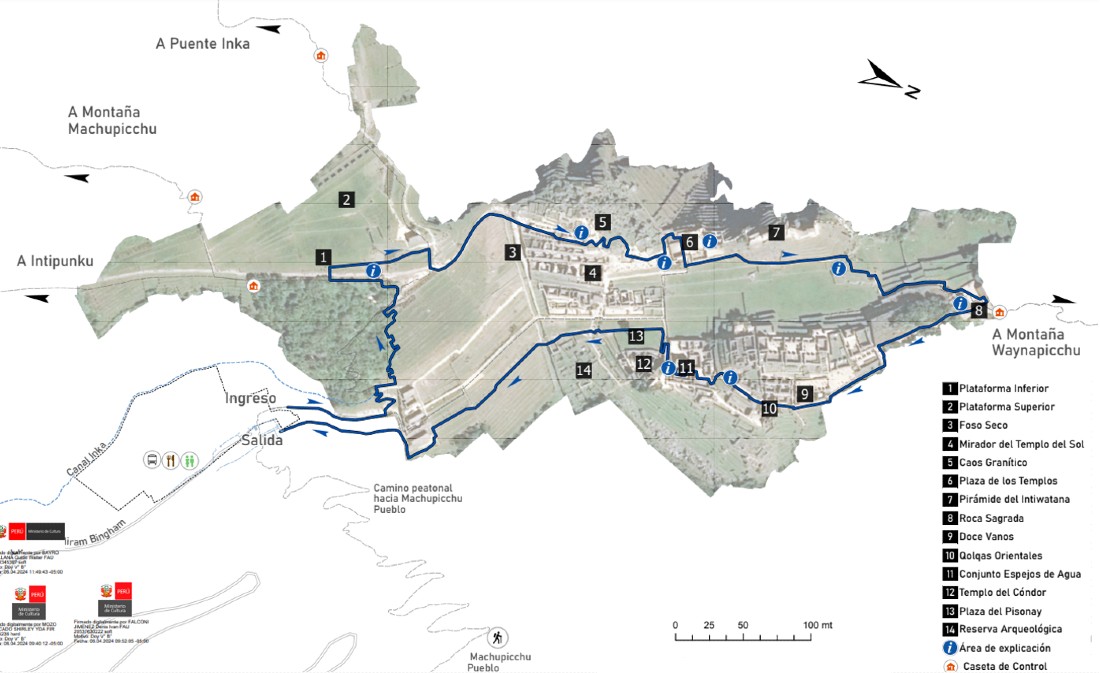
Circuit 3 explores the lower section of Machu Picchu. The route passes through the agricultural terraces before continuing into the urban sector. Here you will find sites including the Water Mirrors, Pisonay Square, the Temple of the Condor and the Sacred Rock.
Two routes are available throughout the year:
- Circuit 3 Route 3-B: the route through the lower section of Machu Picchu.
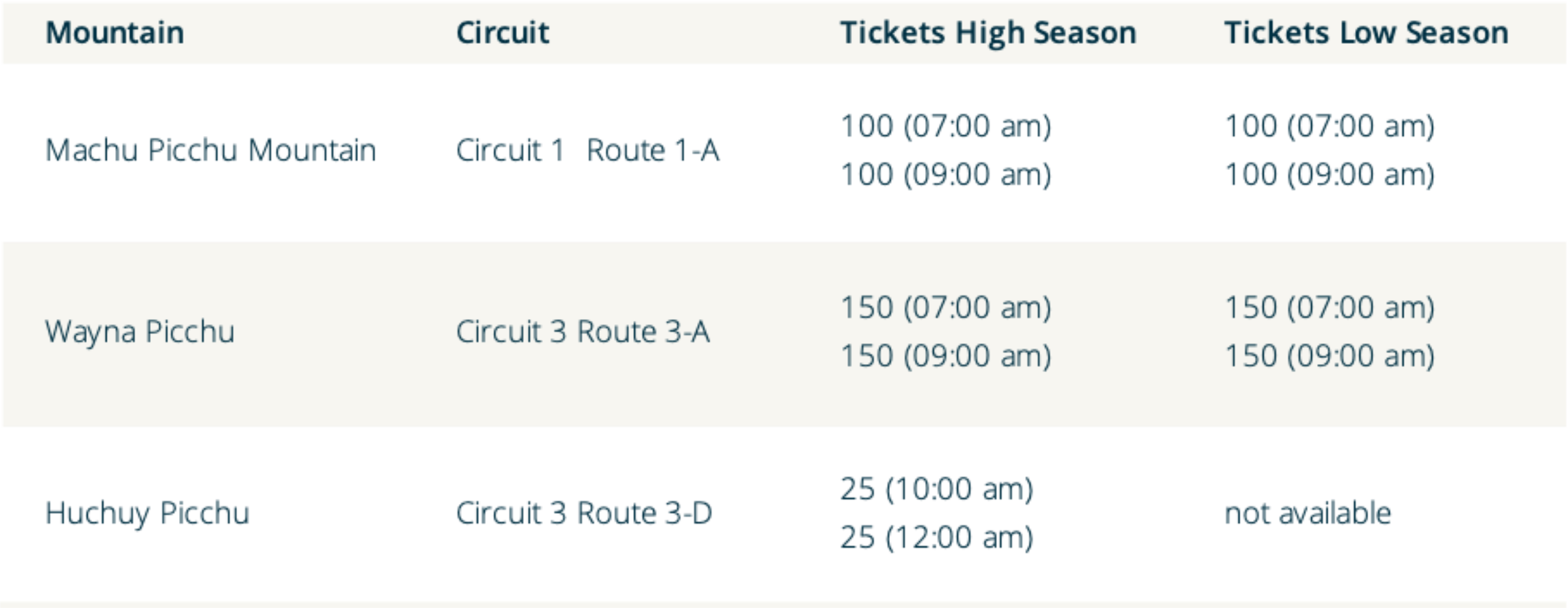
- Circuit 3 Route 3-A: this route combined with the ascent of Wayna Picchu.

During the high season, two additional options are available:
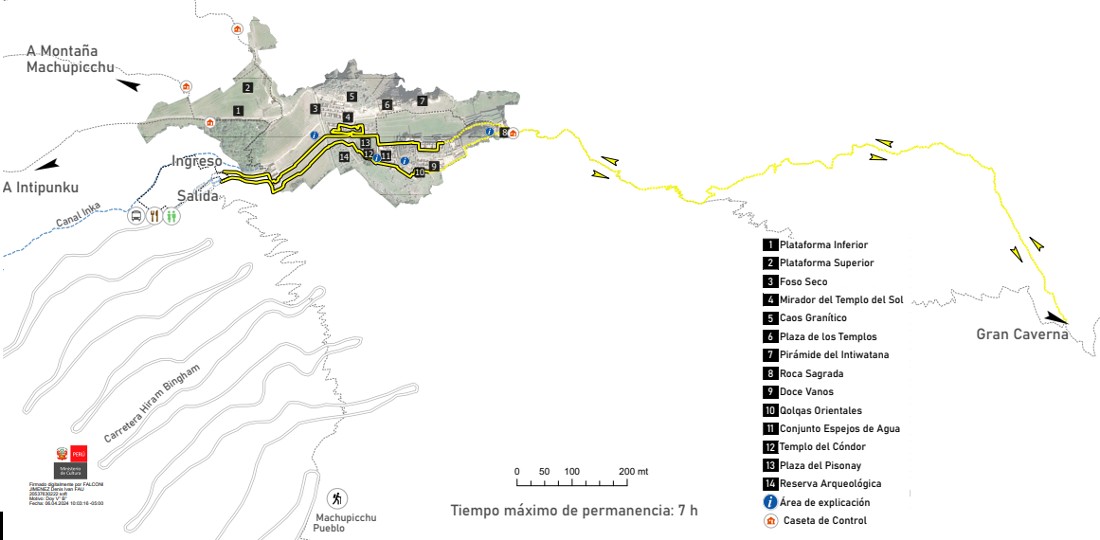
- Circuit 3 Route 3-C: the route combined with a visit to the Gran Caverna, or Great Cave.
- Circuit 3 Route 3-D: the route combined with the ascent of Huchuy Picchu.

Personal details required to purchase tickets
Personal details are required when purchasing tickets for Machu Picchu. Tickets are issued in the traveller’s name and are non-transferable.
For the reservation, details including your name, passport information, nationality and date of birth are required.
The number of visitors permitted per day and per route is limited. We therefore recommend booking tickets well in advance, particularly if you are travelling during a busy period or wish to visit a specific route.
Tickets can be purchased in advance through the official online booking platform of Peru’s Ministry of Culture. A limited number of tickets are also sold each day in Machupicchu Pueblo. As these tickets are subject to availability, this is not a suitable alternative to booking in advance for a pre-planned journey.
Reduced rates for children and students
Reduced rates are available for children, young people and students. Conditions and prices depend on age, nationality and student status. When booking, check which reduction applies to you and which documents you will need to present.
Visitor rules
Several rules apply when visiting Machu Picchu:
- At the entrance, every visitor must present their ticket and a valid identity document.
- You must follow the route corresponding to the ticket you have booked.
- The permitted duration of your visit varies according to the circuit and route.
- Your entrance ticket allows a single entry. It is not possible to leave Machu Picchu and re-enter using the same ticket.
- A guide is not compulsory for all routes, but visiting with a guide naturally provides much more insight into the history and significance of Machu Picchu.
Entry times
When visiting Machu Picchu, you reserve a fixed entry time. Entry times begin at 06:00 and continue in designated time slots throughout the day.
For most entry times, there is a limited tolerance period if you arrive late. This is generally 30 minutes and 45 minutes during periods of high visitor demand.
There is no tolerance period at the separate checkpoints for Machu Picchu Mountain, Wayna Picchu and Huchuy Picchu. If you have booked one of these routes, it is therefore particularly important to arrive on time.
In all cases, make sure you arrive at the entrance well in advance. Once your ticket has been issued, the reserved entry time cannot simply be changed.
Restrictions
There are several restrictions on what you may take into the citadel:
- Large bags, shopping bags and disposable bottles are not permitted inside the citadel.
- You may take only one small bag with you.
- Walking sticks are permitted only for elderly visitors and people with a physical disability and must have a rubber tip.
Surrounding mountains
Some travellers choose to combine their visit to Machu Picchu with an ascent of one of the surrounding mountains. The best-known options are Machu Picchu Mountain, Wayna Picchu and Huchuy Picchu.
Which mountain you can climb depends on the circuit and route for which you have booked a ticket.
Wayna Picchu
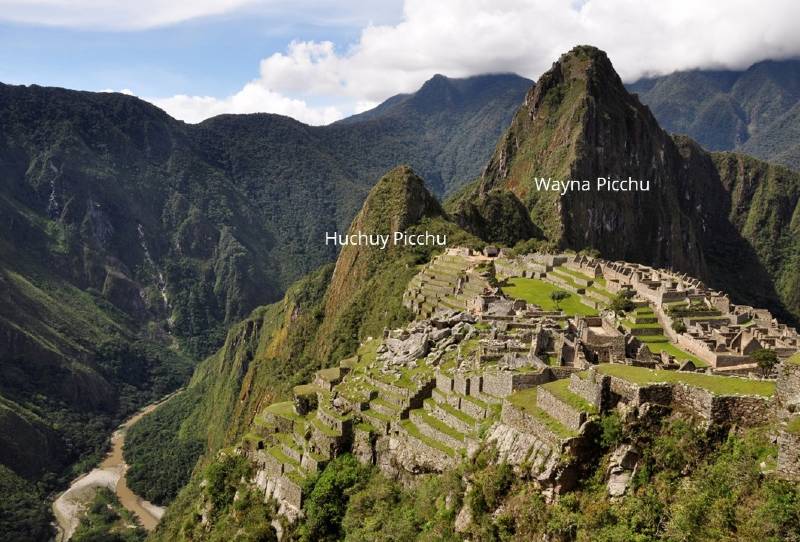
Wayna Picchu is one of the mountain peaks surrounding Machu Picchu. It is probably the best known, as the mountain rises high above Machu Picchu and forms the backdrop to many photographs.
The ascent follows a narrow and very steep trail and takes approximately 45 to 60 minutes, depending on your pace. Once at the top, you are rewarded with spectacular views over Machu Picchu and the surrounding mountains.
As the trail is very narrow and exposed in places, we particularly recommend this hike for experienced and confident walkers. Sturdy footwear is strongly recommended.
The permitted time for a combined visit to Wayna Picchu and Machu Picchu is 5.5 hours.
Huchuy Picchu
Huchuy Picchu is, in a way, Wayna Picchu’s little brother. The mountain is located close to the checkpoint near the Sacred Rock and can be reached by a walk of approximately 15 minutes.
Compared with the other mountain hikes, this route is considerably easier and shorter, making it suitable for less experienced walkers as well.
The permitted time for a combined visit to Huchuy Picchu and Machu Picchu is 3.5 hours.
Machu Picchu Mountain
Machu Picchu Mountain, which is also the Apu – the sacred mountain – of the complex, lies to the south of the citadel, opposite Wayna Picchu. The trail passes partly through dense vegetation and offers beautiful views of Machu Picchu and the surrounding landscape along the way.
It takes approximately 90 minutes to reach the summit of Machu Picchu Mountain, depending on your pace. Much of the trail consists of steps. A good level of fitness and sturdy footwear are recommended for this hike.
The permitted time for a combined visit to Machu Picchu Mountain and Machu Picchu is 7 hours.