Best time to visit Ecuador
Climate, seasons, nature and special travel experiences by month and region - Marianne Salmans

“In Ecuador, no single season determines the weather. In just one day, you can travel from the tropical lowlands to the high Andes.”
When is the best time to visit Ecuador? The short answer is: Ecuador can be visited throughout the year. The best time for your journey depends mainly on the regions you would like to explore and what you hope to experience along the way.
This is largely due to the country’s remarkable geography. From the warm Pacific coast, the landscape rises rapidly towards volcanoes more than 5,000 metres high, before descending on the other side of the Andes into the tropical Amazon. As a result, you can experience very different climates and weather conditions within a single journey.
In the Andes, June to August are generally the driest months and are particularly suitable for walking and mountain activities. Along the coast, December to May is warmer and more humid, while humpback whales can be seen offshore from June to September. In the Amazon, conditions are warm and humid throughout the year and rain is simply part of the rainforest experience.
The best time to visit Ecuador therefore depends not only on the month in which you travel, but above all on where you would like to go and what you would like to experience.
This page focuses on mainland Ecuador. Planning to combine your journey with the islands? Take a look at our guide to the best time to visit the Galapagos as well.
The climate of Ecuador
Three regions, three different climates
Although Ecuador is relatively small, it has enormous variations in altitude. When looking at Ecuador’s climate, the mainland can broadly be divided into three regions: the coast, the Andes and the Amazon. Each has its own seasonal patterns, and even within these regions local conditions can vary considerably.
The coast
Tropical, warm and influenced by the ocean
Ecuador’s Pacific coast has a tropical climate. From around December to May, conditions are warmer and wetter. Temperatures are high, the sea is warmer and rainfall increases. Rain often comes in heavy tropical showers, interspersed with dry and sunny periods.
From June to November, much of the coast is drier and slightly cooler. The influence of the cool Humboldt Current becomes stronger, and low cloud can occur, particularly in the morning.
For nature lovers, this cooler period brings an important attraction. From June to September, humpback whales migrate along the Ecuadorian coast to mate and give birth to their calves. Whales can still sometimes be seen in October. Puerto López and Machalilla National Park are among the best-known places for boat trips to observe these impressive animals.
The Andes
Eternal spring with considerable differences between day and night
In the Andes, the climate is influenced much more by altitude than by the seasons we are familiar with in Europe. Quito, for example, lies almost directly on the equator but at an altitude of around 2,850 metres.
In the valleys and cities, daytime temperatures can be pleasantly mild, while evenings and nights can be considerably cooler. The higher you travel, the lower the temperature becomes. Around the high volcanoes and mountain passes, temperatures can fall to around or below freezing.
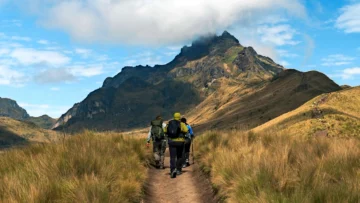
Rain can occur throughout the year. June to August are generally the driest months and are therefore particularly attractive for walking, exploring volcanoes and other outdoor activities.
September is a transitional month, when the likelihood of rain gradually begins to increase again. October and November tend to be wetter.
There is, however, no clearly defined rainy season in Ecuador that applies to the entire country. Even within the Andes, conditions vary according to altitude and location, and showers can occur during the drier months too.
The Amazon
Warm, humid and green throughout the year
There is no distinct dry season in the Ecuadorian Amazon. Conditions are warm and humid throughout the year, and tropical showers can occur in any month.
There are also regional differences within the Amazon. In Yasuní, one of the areas regularly included in our journeys, rainfall is high throughout the year. April and May are among the wettest months on average, while August and September tend to be somewhat less wet. Even then, however, rain remains a normal part of a stay in the rainforest.
This is not a disadvantage of travelling in the Amazon, but one of the reasons the ecosystem is so extraordinarily rich. Rain, sunshine, mist rising above the river and sudden tropical downpours are all part of the experience.
When choosing an Amazon stay, the location of the lodge, the type of ecosystem, the quality of the naturalist guides and the activities on offer are therefore often more important than the month in which you travel.
Ecuador from January to December
Which month is best for your journey?
Now that the differences between the coast, Andes and Amazon are clear, we can look at the year month by month. It is not simply a matter of temperature and rainfall: walking conditions, landscapes, wildlife, cultural celebrations and visitor numbers can all influence your experience.
The month-by-month guide below shows what you can expect in each region and highlights some of the events and conditions that may influence your journey.