How to choose the right Galapagos cruise
Ship, itinerary, islands and cruise length: what should you consider? - Marianne Salmans
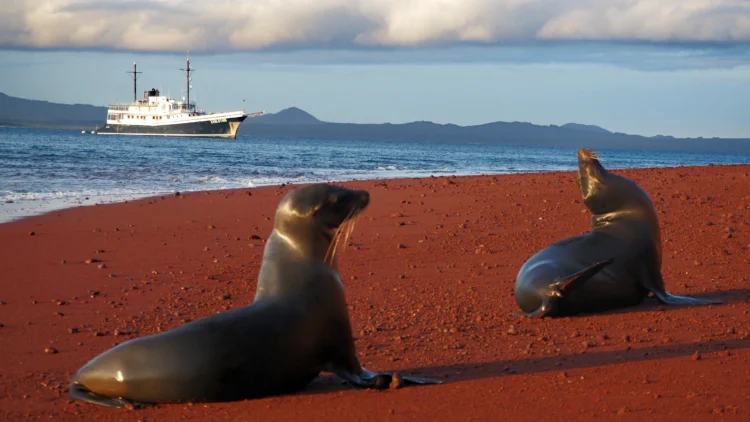
“The best Galapagos cruise is not the most beautiful ship, but the combination of ship and itinerary that suits you”
You have decided that you would like to discover the Galapagos on a cruise. Then perhaps the most difficult part begins: which cruise should you choose?
At first glance, the choice can seem overwhelming. There are dozens of naturalist cruises in different comfort categories, ranging from simpler small-scale vessels to highly luxurious yachts. They have different departure days, itineraries and cruise lengths, and there are also considerable differences on board.
It is tempting to start by looking at the ships. Which cabin appeals to you? Which vessel has the most attractive sun deck? Would you like a jacuzzi, a balcony or perhaps a suite?
But for me, the choice starts somewhere else: first the itinerary, then the ship.
After all, a beautiful ship is not necessarily the best cruise if the itinerary does not match what you would like to see and experience in the Galapagos.
What would you most like to see and experience?
This is almost always the first question I ask.
Perhaps you particularly enjoy snorkelling and hope to encounter penguins, sea lions and sea turtles underwater. Maybe you are a keen birdwatcher and the waved albatross, frigatebirds or blue-footed boobies are high on your wish list. Or perhaps it is the volcanic landscapes, giant tortoises and iguanas that appeal to you most.
Not all animals occur on every island. Some species have a very limited distribution, while others are only present during certain times of the year. Landscapes and activities also vary considerably between visitor sites.
If, for example, you would particularly like to discover the rugged western side of Isabela and Fernandina, you will need a different itinerary from someone for whom Genovesa or Española is a priority.
That is why, when you have specific interests, I first look at which islands and visitor sites best match them. Only then does it become clear which cruise itineraries are worth considering.
How do Galapagos cruise itineraries work?
This is an important part of choosing a cruise and, at the same time, something that is often presented rather confusingly online.
Every naturalist cruise operates a fixed 15-day cycle through the archipelago. This complete itinerary is then divided into shorter cruises, with passengers joining and leaving the vessel along the way. How the cycle is divided varies from ship to ship. Some vessels, for example, offer two 8-day itineraries, while others have several passenger changeovers and therefore offer a range of shorter cruises.
Passenger changeovers take place at Baltra, Puerto Ayora on Santa Cruz and Puerto Baquerizo Moreno on San Cristóbal, depending on the ship’s itinerary.
This means that two cruises of the same length can be completely different in terms of what you experience. An 8-day cruise on one ship may visit an entirely different combination of islands and visitor sites from an 8-day cruise on another.
So never look only at the number of days. The actual itinerary is far more important.
How long would you like to cruise?
The length of your cruise plays an important role in how much variety you can experience.
On a shorter cruise, you will discover a smaller part of the archipelago. This can work very well if you have limited time or are combining your cruise with a stay on one or more of the islands.
A longer cruise will generally allow you to reach a greater variety of landscapes, ecosystems and wildlife areas. You are also less likely to feel that it is time to leave just as you have settled into the rhythm of life on board.
When comparing cruises, bear in mind that the number of cruise days is not the same as the number of full days you actually spend exploring the Galapagos. On the first day, you generally board around lunchtime, followed by your first excursion in the afternoon. On the final day, you will often leave the ship shortly after an early breakfast.
A 5-day cruise therefore effectively gives you around 3.5 to 4 days to experience the archipelago. On a longer cruise, these arrival and departure days account for a smaller proportion of your overall trip, leaving you with more full days for excursions.
For many travellers, I find that a cruise of around eight to ten days offers a good balance between the length of the cruise and how much you can experience. But again, do not look only at the number of days: consider the itinerary and what you will actually visit during that time.
Which departure date best suits your interests?
An itinerary may look exactly right on paper, but it also needs to operate at the time you are travelling to the Galapagos.
Departure days are fixed. This means that the ship, itinerary and your travel dates are closely connected.
The season can also play a role. The Galapagos can be visited throughout the year, but wildlife activity changes with the seasons. Breeding periods, courtship behaviour, young animals and the presence of certain species can make a particular itinerary more interesting at one time of year than another.
Conditions on and below the water also change. Water temperature, underwater visibility and sea conditions vary throughout the year.
If you have specific wildlife or activity interests, I therefore always consider both the itinerary and the time of year.
Which comfort level suits you?
Once we know which itineraries and departure dates are of interest, we can start comparing the ships themselves.
At Aves Travels, we divide naturalist cruises into four comfort categories:
Comfort
Functional, simpler vessels with relatively little personal space. Cabins and communal areas tend to be compact and facilities on board are more limited.
Premium
More space and comfort, well-appointed cabins and communal areas, and generally a higher level of service and facilities.
Luxury
Spacious, stylish vessels with comfortable cabins or suites, a high level of service, good cuisine and extensive facilities on board.
Ultra Luxury
The most exclusive vessels in the archipelago, offering plenty of personal space, spacious suites, high-quality cuisine and a very high level of service and guiding.
A category never tells the whole story, however. Even within the same comfort level, ships can differ considerably.
Large or small ship?
Naturalist cruises in the Galapagos are relatively small-scale, but there is a clear difference between a yacht carrying, for example, 16 passengers and a larger expedition vessel carrying 100 passengers.
On a small ship, everyone generally follows the same programme. The group can get on and off the ship quickly and, because of the small scale, you are close to everything happening around the vessel. If something unexpected occurs, it is also easier to respond quickly and spontaneously. This proximity to nature and flexibility are important advantages of a small ship.
A larger vessel offers different advantages. There is often more personal space on board, with larger outdoor decks, several lounges and more extensive facilities. Passengers may also be able to choose between different activities during an excursion period, such as a walk, snorkelling or a panga ride. A larger vessel can also feel more stable at sea.
On the other hand, getting several groups on and off the ship requires more time and organisation. The programme therefore tends to be more structured, with less flexibility to respond spontaneously to what is happening in the surrounding area.
Choosing between a small and a larger vessel is therefore about more than passenger numbers. It is also about how you would like to experience the Galapagos: small-scale and flexible, or with more space, facilities and a choice of activities.
Look beyond your cabin
Photographs of the cabins are often among the first things you notice when comparing ships, but during a Galapagos cruise you will spend a large part of your time outside your cabin.
I therefore also look at aspects such as:
- the amount of indoor and outdoor deck space;
- sufficient seating in both sun and shade;
- the layout of the lounge and dining area;
- space on the observation or sun deck;
- the number of pangas and how easy it is to get in and out of them;
- snorkelling equipment and any wetsuits provided;
- kayaks, paddleboards or other additional activities;
- the quality and variety of the meals;
- how dietary requirements and food allergies are catered for;
- Wi-Fi and other facilities on board.
A spacious cabin is pleasant, but a well-designed ship should also make you feel comfortable everywhere else on board.
How important is the naturalist guide?
The naturalist guide plays a major role in how you experience the Galapagos. During walks, snorkelling activities and panga rides, your guide spots wildlife, explains animal behaviour and brings the extraordinary ecology and geology of the islands to life.
One naturalist guide accompanies a maximum of 16 passengers. A ratio of one guide to 16 travellers already provides a good, small-scale nature experience and is common on many vessels in the Galapagos.
Some of the most luxurious ships deliberately operate with even smaller groups. A vessel carrying 16 passengers may, for example, have two naturalist guides, meaning you explore with no more than eight travellers per guide. There are also vessels carrying around 20 passengers with two naturalist guides.
A smaller group provides additional personal attention. There is more opportunity to ask questions, you are closer to the guide during walks and it is easier to respond to what the group encounters along the way. A smaller group can also make the experience more personal when snorkelling or exploring by panga.
That is why, when comparing ships, I look not only at the total number of passengers but also at the ratio of passengers to naturalist guides. A ratio of 1:16 is already good; a more favourable ratio is one of the additional benefits you will find particularly on some vessels in the highest categories.
Service and crew make more difference than you might think
Two ships may appear to offer roughly the same level of comfort in photographs, yet provide a very different experience.
How attentive is the crew? How smoothly are panga transfers organised? Is a drink waiting for you when you return from an excursion? Are dietary requirements handled well? Is everything on board well maintained? And does the service feel personal or rather more distant?
These kinds of details make a considerable difference to how you experience a ship after several days on board.
That is why, whenever possible, I visit the vessels Aves Travels works with myself. Photographs, technical specifications and brochures can tell you a great deal, but they cannot tell you how a ship actually feels when you step aboard.
What if you are prone to seasickness?
This can also influence your choice of ship and itinerary.
Larger vessels generally move differently from small yachts, and the design of the ship can also make a difference. Some itineraries and crossings are also more exposed to movement at sea than others.
The season plays a role in sea conditions as well.
Being prone to seasickness does not automatically mean that a Galapagos cruise is unsuitable for you. It is, however, sensible to take it into account from the outset when selecting your ship and itinerary.
There is no single best cruise
I am regularly asked: “What is the best ship in the Galapagos?”
There is no single answer.
For one traveller, a small yacht with plenty of personal attention is ideal. Someone else may prefer the space and stability of a larger vessel. For a keen birdwatcher, a particular itinerary may be the deciding factor, while someone who mainly wants to snorkel will have very different priorities. And travellers who value a spacious suite and excellent cuisine will look at a different selection of ships again.
The best Galapagos cruise is therefore not simply the most expensive, newest or most luxurious ship.
It is the combination of itinerary, departure date, cruise length, ship and comfort level that best matches what you would like to experience.
That is also why, when putting together a Galapagos journey, I start by asking a number of specific questions. This usually allows me to narrow down dozens of vessels and an even greater number of possible itineraries to a small selection that genuinely suits you.
And that usually makes the choice considerably easier.
Still wondering whether a cruise is the best way for you to experience the Galapagos?
Read: Galapagos decision overload? Cruise or island hopping.


